
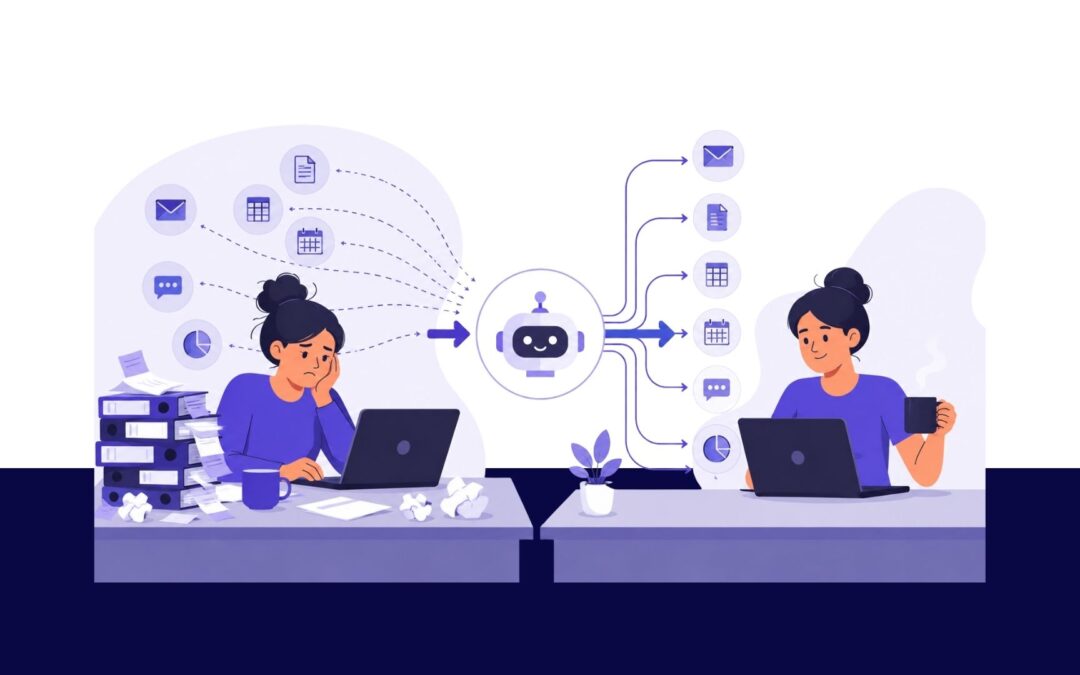
How a Growing Service Company Cut Administrative Time From 46 Minutes to 1.5
Growth can expose problems that are easy to overlook when a company is smaller. This business process automation case study follows a multi-state service company where rising demand meant more completed jobs—and more administrative work associated with every customer.
Each job required customer outreach, scheduling, appointment reminders, paperwork, invoicing, follow-up and delivery of completed documents. Individually, none of those tasks was especially complicated. Repeated hundreds or thousands of times, however, they consumed a significant amount of staff time.
Content Fresh began by conducting an operational audit of the company’s existing workflow. We mapped the administrative steps associated with a typical job and reviewed where staff members were spending time on repetitive communication, paperwork, scheduling and follow-up.
The audit established a baseline of approximately 46 minutes of administrative processing time per job. With a measurable starting point, we could identify which parts of the process required staff involvement and which predictable tasks could be supported through automation.
Connecting the workflow
Content Fresh connected a series of software tools to support routine steps in the customer journey, including outreach, scheduling, appointment reminders, intake and paperwork, invoicing, follow-up and document delivery.
The goal was not to eliminate personal customer service or automate every interaction. It was to reduce the time employees spent completing repetitive tasks and to create a more consistent process for moving each job forward.
Once the new workflow was implemented, Content Fresh conducted a before-and-after review. Administrative processing time dropped from approximately 46 minutes per job to 1.5 minutes. The difference was important because the company was also experiencing significant growth. Completed jobs increased from 1,018 in 2023 to 2,063 in 2025, while the company’s service area expanded from one state to four.
Automation was one part of a larger growth program that also included marketing, search visibility, advertising and increased market demand. It did not create the company’s growth on its own. It did, however, provide a stronger operational foundation for handling a larger volume of work without administrative resources increasing at the same rate.
Start with the process, not the software
One of the most important lessons from the project was that the automation work began with an audit, not with a technology platform. By first documenting the existing process, Content Fresh could identify repetitive steps, handoffs between systems and areas where staff time was being used unnecessarily. Establishing a baseline also made it possible to measure the result rather than simply describe the new workflow as more efficient.
For service businesses that are automating business processes, the details will differ, but the opportunity often begins in the same place. Customer inquiries, scheduling, reminders, paperwork, invoicing, follow-up, and final document delivery are all areas where repetitive work can accumulate. When a task occurs with every customer, even a relatively small inefficiency can become significant as the business grows.
For this company, reducing administrative processing time from approximately 46 minutes to 1.5 minutes per job created additional capacity at an important point in its growth. The project demonstrates why business process automation is most useful when it begins with a clear understanding of how the business already operates, identifies a measurable problem and uses technology to solve that specific problem.
Content Fresh provides business process automation services for service organizations. We help teams evaluate existing workflows, identify administrative bottlenecks, and build practical workflow automations designed to support sustainable growth.